
Climbing Mount Toubkal: what to know before you go
Toubkal (4,167 m) is a non-technical climb from late spring to autumn, done in two or three days from Imlil with a compulsory licensed guide and a night at the 3,207 m refuges; winter needs crampons, an ice axe and experience.

In this guide
Mount Toubkal (4,167 m), the highest summit in North Africa, is a long, steep walk rather than a technical climb from late spring to autumn. There are no ropes, but you gain more than 2,000 m from the trailhead and spend a night above 3,000 m. Most people do it in two days from Imlil, about 65–70 km south of Marrakech, with a night at the refuges at 3,207 m. A third day makes it easier and safer. Plan to go with a licensed local mountain guide: current guidebooks and recent trekkers agree that one is compulsory between Imlil and the summit. In winter it becomes a different mountain, with snow, ice and avalanche risk, and you need crampons, an ice axe and experience.
The route from Imlil, step by step
Almost everyone uses the standard route up the valley south of Imlil. It is well trodden and, in summer, easy to follow, but it is long, and the last 1,000 m are on loose stones.
Day 1: Imlil to the refuges (about 5–6 hours)
From Imlil (about 1,740 m) the trail passes the village of Aroumd, crosses the broad, stony valley floor and climbs steadily to the shrine of Sidi Chamharouch, where guides usually stop for a meal or a drink. From there it zigzags up the mountainside to the two refuges at 3,207 m. Count roughly 11 km and close to 1,500 m of ascent: around five hours for a fit walker, six with breaks.

Day 2: summit and descent (8 hours or more)
Groups leave the refuges before dawn, and many aim to be on top around sunrise. The path climbs scree and boulders to the Tizi n'Toubkal saddle (3,975 m), then keeps to the western side of the ridge, past false summits, to the metal pyramid on the top. Allow about 2.5–4 hours up, depending on how well you handle the altitude. You then return to the refuges and walk all the way down to Imlil, so summit day often means 8 hours or more on your feet.
Tip: Agree with your guide on a turn-around time before you set off. On a cold or windy morning, turning back below the top is a normal decision, not a failure.
Two days or three?
- Two days (the most common package): Marrakech to Imlil and up to the refuges on day 1, summit and all the way down on day 2. It's the cheapest option, but day 2 is long, and you go from Marrakech to 4,167 m in barely 24 hours.
- Three days: either sleep in Imlil before starting, or spend a second night at the refuges after the summit. Both give your body more time and cut the longest day in half.
The NHS advises against going from below 1,200 m to above 3,500 m in a single day, and against sleeping more than 500 m higher than the night before once you are above 3,000 m. The two-day plan stretches both rules. If you can spare the day, take it: a night in Imlil first is the simplest way to start better acclimatised.
Do you need a licensed guide?
Yes, in practice. In December 2018, two European hikers were murdered in an isolated part of the High Atlas near Toubkal. Since then, the ascent has had to be made with an official local mountain guide. Le Routard's current guide to the massif states this plainly, and trekkers who climbed in 2026 report the same. We could not find the text of the regulation published online, and the way checks are carried out can change, so:
- book a guide who holds the official Moroccan mountain guide card, through an agency or the guide offices beside the taxi car park in Imlil, and ask to see the card;
- carry your passport, as some trekkers report registering near Imlil;
- confirm the current rules with your guide or agency when you book.
Official advice points the same way. Canada asks travellers to hire only official guides recommended by hotels, agencies or tourist offices, and not to hike alone in remote mountain areas.
The refuges at 3,207 m
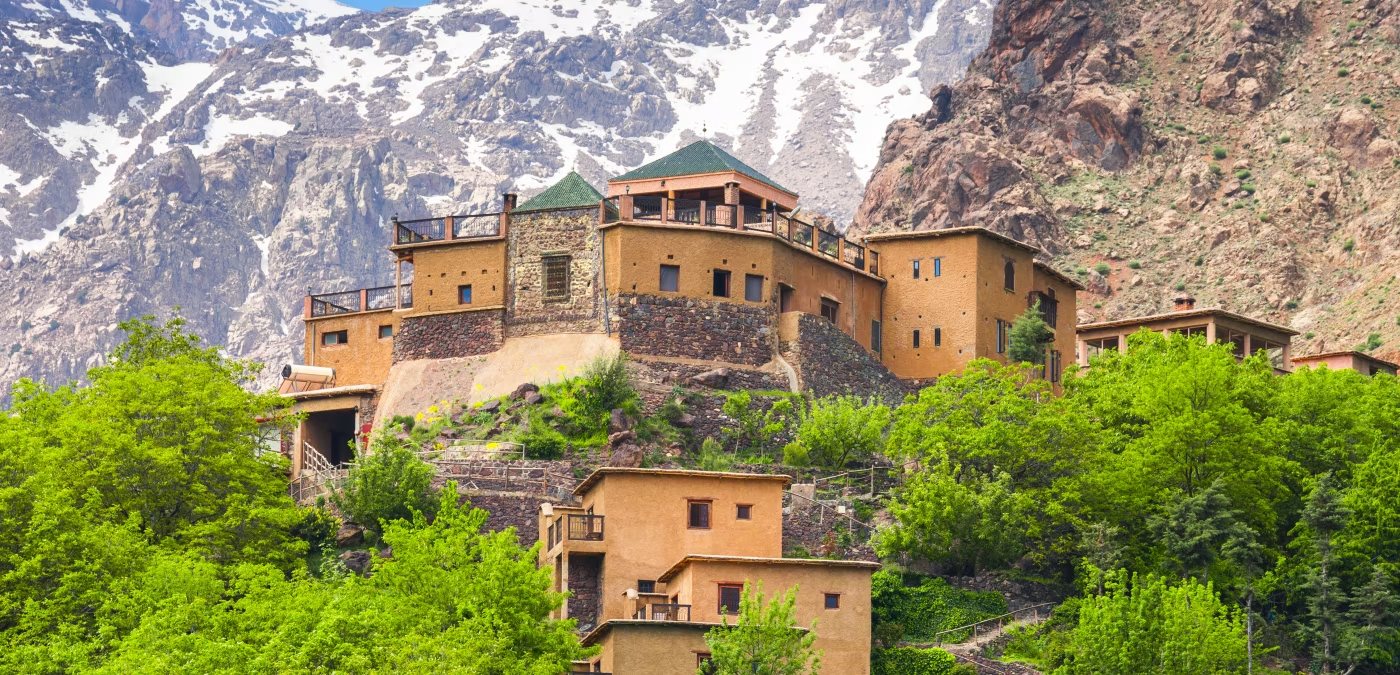
Two buildings stand side by side below the summit: the Refuge du Toubkal (also called the Neltner refuge), run by the Club Alpin Français, and Les Mouflons, a private refuge. Both sleep most guests in dormitories with bunk beds; Les Mouflons has a few private rooms if you book well ahead. Meals are served in a dining hall and are usually part of a guided package: dinner on arrival and an early breakfast before the summit. Your agency normally makes the booking.
What trekkers reported in 2026:
- Electricity runs only for a short spell in the evening, so bring a charged power bank.
- There is no public Wi-Fi; phone signal is possible but not guaranteed.
- Hot showers cost extra, and the water isn't always hot. Toilets are basic: bring toilet paper and hand gel.
- A small shop sells snacks and bottled water at mountain prices (around 15 MAD for 1.5 litres). Carry dirhams in small notes.
- Camping is possible on the grounds, usually arranged by trekking agencies.

Tip: Dormitories are crowded and noisy in high season. Earplugs and a sleeping-bag liner make the night much better.
When to go
| Months | Conditions | What it means for you |
|---|---|---|
| April–May | Snow melting high up, mild in the valleys | One of the best windows; early in the season, ask whether crampons are still needed |
| June–August | Dry and settled, hot low down, chilly nights at the refuges | The busiest period; no technical gear needed in normal conditions |
| September–October | Mild days, fewer walkers, clear views | The other best window |
| November–March | Snow and ice, nights well below freezing, avalanche risk | Only for experienced hikers with crampons, ice axe and a qualified winter guide |
Rain also matters: Canada warns that flash floods are frequent from November to March and can be especially dangerous in High Atlas valleys. If heavy rain is forecast, ask your guide about the river crossings below the refuges.
Altitude, fitness, gear and mules
Altitude sickness
According to the NHS, altitude sickness usually starts above 2,500 m: headache, nausea, dizziness, tiredness, loss of appetite and poor sleep. If you have symptoms, tell your guide and don't go higher; if they get worse, go down. Confusion, loss of balance, breathlessness at rest or a persistent cough are emergency signs: descend at once and get help. Drink plenty of water and skip alcohol.
Fitness
The climb is strenuous but not technical in summer. It suits regular walkers with good stamina who are used to long days on steep ground. Before you go, train with several hikes of 5–6 hours with real ascent, and work on your knees for the descent.
Gear for spring to autumn
- Broken-in walking boots with ankle support
- Warm layers: fleece, down jacket, waterproof and windproof shell
- Hat, gloves, sunglasses and high-factor sunscreen
- Head torch for the pre-dawn start
- A 20–30 litre daypack and water bottles (a filter bottle is useful)
- Sleeping bag or liner: ask your agency what the refuge provides
Winter extras: crampons, ice axe, gaiters, goggles and warm gloves. Crampons, ice axes and sleeping bags can be hired in Imlil or through your agency, but check the fit before you leave the village.
Mules
Mules carry your main bag and the group's supplies up to the refuges, led by a muleteer your guide hires. They are included in most packages. Keep everything you need during the day in your own daypack, since the mule may arrive after you.
Getting there and what it costs in 2026
From Marrakech to Imlil
- Shared grand taxi: taxis leave from a departure point about 1 km south of Bab er-Rob, for about 40 MAD a seat and a journey of 75–90 minutes. They get scarce after late morning, so go early.
- Private transfer: included in most packages, about 1.5 hours to Imlil.
What you'll pay
- Two-day guided package from Marrakech (transfer, guide, mule, refuge night and meals): in October 2026, one local trekking operator listed about €150–190 per person in summer and €180–220 in winter, depending on group size. Cheaper offers exist on booking platforms; check exactly what they include.
- Extras: tips for the guide, cook and muleteer, drinks and snacks at the refuge, hot showers, and gear hire.
Tip: Prices vary with season, group size and the refuge you sleep in. Ask for the full list of what's included, in writing, before you pay a deposit.
Safety and emergency numbers
Canada advises a "high degree of caution" across Morocco, and France Diplomatie (updated September 2026) points out that rescue capacity in the mountains is often limited, especially in remote areas. A guide, a group and sensible timing are your best protection. Make sure your travel insurance covers trekking at this altitude, including evacuation. The High Atlas south-west of Marrakech was also hit by a strong earthquake in September 2023; ask your agency about current conditions on the trail and in the villages.
Emergency numbers (checked on GOV.UK and France Diplomatie, October 2026): police 190 (or 19), gendarmerie 177 outside towns, which covers the mountains, and ambulance and fire 150 (or 15). Save your guide's and agency's numbers too.
Checklist before you go
- Licensed guide booked and their card checked
- Passport with you
- Two or three days, depending on your fitness and acclimatisation
- Refuge or camp confirmed, and what the package includes
- Season-right gear, plus crampons and an ice axe in winter
- Insurance that covers trekking above 4,000 m
- Cash in dirhams for tips and the refuge shop
What to book
Most climbers sleep in Marrakech the night before and the night after. Browse riads and hotels in Marrakech and choose somewhere that makes an early pickup easy. For more trip planning, see all our guides.
Questions travellers ask
Can I climb Toubkal without a guide?
No. Since two hikers were murdered in December 2018, an official local mountain guide has been required between Imlil and the summit. Book a guide with the official card and confirm the current rules when you book.
Is Toubkal hard? Do I need climbing experience?
From late spring to autumn you need no climbing skills, but you do need stamina: more than 2,000 m of ascent, scree and a summit day of 8 hours or more. In winter you must be able to use crampons and an ice axe.
Is two days enough for Toubkal?
Yes, it's the most common plan, but it's fast for acclimatisation and the second day is very long. Three days, with a night in Imlil first or a second night at the refuges, make the climb safer and more enjoyable.
When is the best time to climb Toubkal?
April–May and September–October are the most comfortable; summer is dry but busy. From November to March, snow, ice and avalanche risk make it a climb for experienced, properly equipped hikers only.
How much does climbing Toubkal cost?
In October 2026, a two-day guided package from Marrakech (transfer, guide, mule, refuge and meals) cost about €150–190 per person in summer and €180–220 in winter with one local operator. Add tips, drinks, showers and gear hire.
Where to stay and what to book in Marrakech


Sources & fact-check
Checked on 22 October 2026 against the sources below. Rules, prices and safety advice change — confirm with official sources before you travel.
- Morocco travel advice: getting help (emergency numbers) — GOV.UK (Foreign, Commonwealth & Development Office)
- Maroc – Conseils aux voyageurs : Sécurité — France Diplomatie (ministère de l'Europe et des Affaires étrangères)
- Maroc – Conseils aux voyageurs : Contacts utiles — France Diplomatie (ministère de l'Europe et des Affaires étrangères)
- Travel advice and advisories for Morocco — Government of Canada
- Altitude sickness — NHS
- Massif du Toubkal — Le Routard
- Toubkal National Park — Wikivoyage
- Things to know before you climb Mount Toubkal — Explore Worldwide
- Toubkal refuge: what to expect — Jessie on a Journey
- Toubkal trek 2 days (prices checked October 2026) — Amazing Toubkal Trek
Keep reading
 Nature & desert
Dakhla Kitesurfing in Dakhla: lagoon, wind season, camps and costs
Dakhla is one of the world's most reliable kite spots: a flat lagoon for beginners, waves on the ocean side and wind on almost every day fro... 10 min read · checked Oct 2026
 Nature & desert
Tinghir Dades and Todra gorges: what to know before you go
Both gorges sit just off the Ouarzazate–Merzouga road, but their best parts, the Dades switchbacks and a walk in Todra, need one or two nigh... 9 min read · checked Oct 2026
 Itineraries
Marrakech Atlas Mountains day trips from Marrakech: which one to choose
Lalla Takerkoust is under an hour away, Ourika and Imlil about an hour and a half, while Ouzoud and Telouet mean close to three hours' drive... 10 min read · checked Oct 2026